For committees and building managers
Who pays, what a quote should be built on, and how to put a resolution together that survives a general meeting.
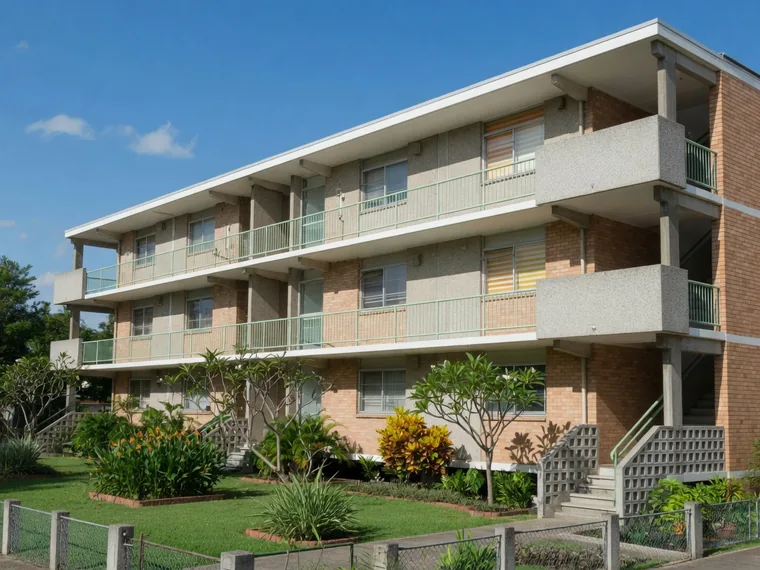
On a unit block, the parts concrete cancer affects — the frame, walkways, car parks and often the balcony slabs — are generally common property, which makes the decision a committee's rather than an individual's. Concrete Cancer Brisbane does the inspection, the written scope and the repair; this page is about everything around that, because the technical part is usually the easy part.
In Queensland, common property is generally the body corporate's responsibility and lot property is the owner's. Concrete cancer complicates that because balconies sit right on the boundary and the answer turns on the plan — whether it is a building format plan or a standard format plan — and on the by-laws. A slab can be common property while the tiles and the balustrade on top of it are not.
Get this resolved before scoping the work, because it decides who funds it and whether the levy is general or a contribution lot by lot. We are not lawyers and this is not legal advice. Your body corporate manager or a strata lawyer should confirm it in writing, and it is worth the small cost of asking.
Someone competent walks the building, hammer taps, takes cover readings and maps what is actually affected — not what is visible. This is the document everything else is built on.
Quantified work: square metres of patch repair, linear metres of injection, number of anodes, access method, reinstatement. Without this a price cannot be checked, and a price that can be checked is the basis of a defensible decision.
Every line of the quote ties back to a line of the scope. If the scope changes, the quote changes with it, in writing, before the work does.
If there is section loss, a post-tensioned slab, or any question about capacity, a structural engineer's report before committing. It is cheaper than the argument that follows not having one.
Sinking fund, special levy, or staged over years. The forecast almost never anticipated this, so expect to be choosing between a levy and a staged programme.
We do the repair from breakout to reinstatement as one job. On a large job the committee may also appoint its own superintendent to check variations against the scope.
The objection you will meet is not that the work is unnecessary — it is that it is expensive and it could wait. The strongest answer is not urgency, it is arithmetic. Show what the repair costs now, what the same repair costs once spalling has spread, and what the building's obligations are regarding falling material. Owners discount alarm and respond to numbers, and on this defect the numbers genuinely favour acting.
It also helps to be plain that this is not a defect of maintenance or neglect. Buildings of this era were constructed to the cover requirements of their time. Reaching this point at fifty years old is ordinary, not a sign that anyone failed.
Where the whole job is genuinely unaffordable in one year, staging is legitimate provided it is prioritised on risk rather than on visibility. That means anything overhead or over an access path first, then structural elements, then durability work, then cosmetic reinstatement. Staging on appearance — doing the street elevation because it is what owners see — is how buildings end up spending more overall.
An inspection and a written scope for $450 plus GST, then a fixed quote on that scope and the repair itself. If your committee needs a structural engineer's report as well, say so before the inspection — it is a different document for a different purpose, and on a serious job you may want both.
The suburbs below cover the 1960s–80s walk-up belt and the bayside strip, where salt air can reach the steel faster.
Tell us what the concrete is doing. We will inspect it and give your committee a written scope and a quote it can actually vote on.