Chermside, QLD
Chermside: inland walk-ups where carbonation does the work.
Concrete Cancer Brisbane inspects and repairs concrete in Chermside, where the typical buildings are 1960s–80s walk-up units, and the written scope comes before any repair price.
Chermside is far enough from the bay that chloride is a minor factor, which makes it a good illustration of the other mechanism. Carbonation works slowly and evenly: atmospheric carbon dioxide reacts into the concrete over decades, drops its alkalinity, and eventually reaches the depth of the steel. Damage arrives later than on the bayside but arrives everywhere at once rather than in patches. On a Chermside block of this age, carbonation predicts widespread light spalling rather than the severe localised failures chloride causes on the bayside.
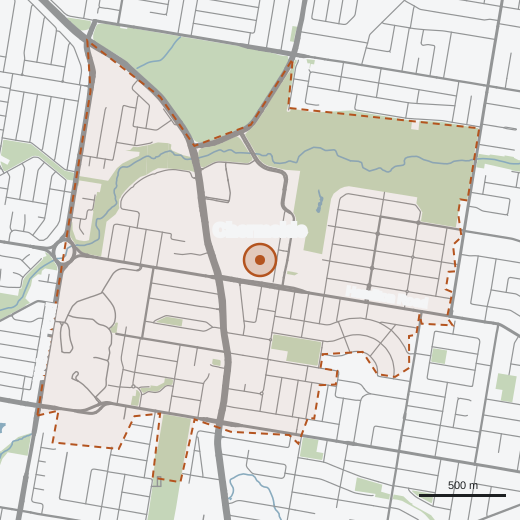
| Typical buildings | 1960s–80s walk-up units |
|---|---|
| Nearest Moreton Bay shore (salt air) | about 7.7 km (straight line) |
| Distance to the Brisbane River | about 6.5 km (straight line) |
| Ground height within 250 m | about 19–36 m above sea level |
| Brisbane CBD | about 9.5 km (straight line) |
| Main streets in the suburb | Webster Road, Murphy Road, Hamilton Road and Rode Road |
| Parks in the suburb | Burnie Brae Park, John Patterson Park and Dead Mans Gully Park |
Chermside's centre is 7.7 km from the bay and 6.5 km from the Brisbane River. At those distances airborne chloride is a small factor, which supports the detail above: carbonation is the mechanism to test first. A phenolphthalein spray on a fresh break shows how deep carbonation has reached, and a cover meter shows how deep the steel sits. Where the first depth has passed the second, corrosion has started.
Prices are on the cost page and the measuring method is on the about page. Nearest suburbs with a page here: Hamilton (about 7 km), Sandgate (about 8 km), New Farm (about 9 km), Kangaroo Point (about 10 km).
The suburbs below cover the 1960s–80s walk-up belt and the bayside strip, where salt air can reach the steel faster.
Tell us what the concrete is doing. We will inspect it and give your committee a written scope and a quote it can actually vote on.