The earliest sign
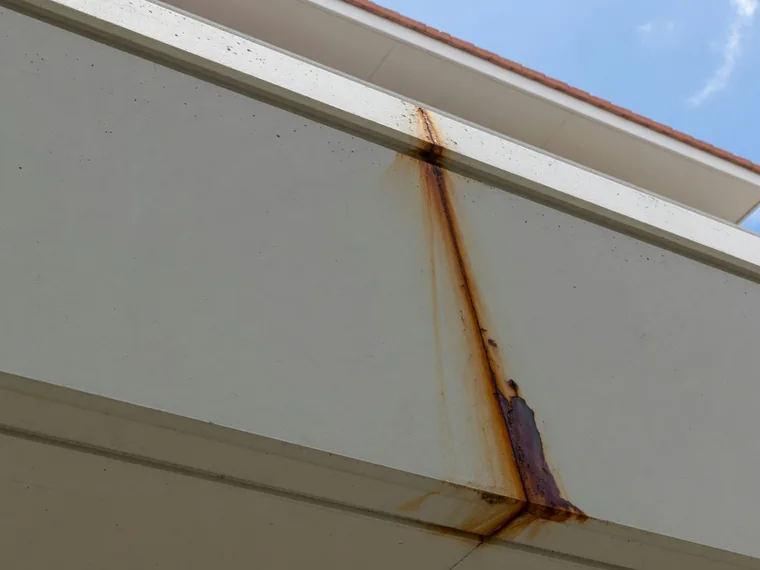
A brown stain bleeding out of a soffit or a balcony edge is corrosion that has already started. It is the cheapest moment to act, and the easiest sign to paint over.
On many buildings, the first sign of concrete cancer was a stain that somebody covered up two years earlier. This Concrete Cancer Brisbane page is about why that is the expensive choice.
Concrete is porous. When reinforcement corrodes, iron oxide is carried through those pores by moisture and deposits at the surface. So a stain is not dirt and it is not the concrete discolouring — it is rust from inside, arriving at the outside. By definition the steel has already lost its protection.
Small isolated spots, often in a grid, from bar chairs or tie wire left too close to the surface during the pour. Cosmetic, and it does not spread.
A rusting handrail, bracket or downpipe staining the concrete below it. The giveaway is that the stain runs downward from a source rather than emerging from the concrete.
Occasional rust-coloured spotting from pyrite or iron-bearing particles in the aggregate. Blotchy and random, not linear.
Follows a straight line, because it follows the bar. Frequently accompanied by fine cracking along the same line. This is the one that matters.
A coating over active corrosion traps moisture against concrete that is already deteriorating, and it removes the only evidence anyone had. The steel keeps losing section invisibly, and the next thing the building sees is spalling rather than staining — which is a materially bigger repair. Coatings have a genuine role, but after the repair and never instead of it.
Tap the area and the concrete around it. If any of it sounds hollow, the cover has already separated and this is no longer early. Either way, a stain following a straight line warrants an inspection while the repair is still small — see what an inspection involves and what deferring actually costs.
The suburbs below cover the 1960s–80s walk-up belt and the bayside strip, where salt air can reach the steel faster.
Tell us what the concrete is doing. We will inspect it and give your committee a written scope and a quote it can actually vote on.